Something shifted this year.
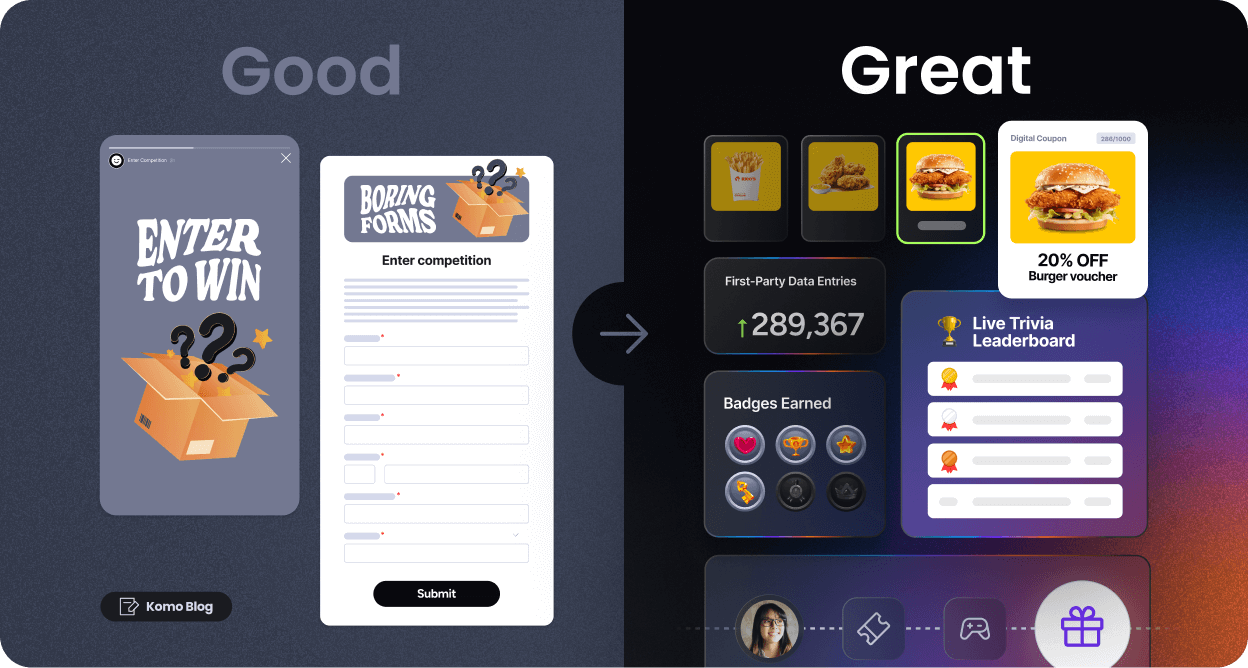
For a long time, engagement was the thing brands added at the end. The activation. The campaign. The moment designed to grab attention, collect some data, and hope something stuck.
2025 was the year that stopped working.
Not because audiences got harder to reach—though they did. Not because budgets got tighter—though they did. It stopped working because brands finally realized that running more campaigns wasn't the answer. Building something that compounds was.
The teams that figured this out stopped asking "what's our next activation?" and started asking "what's our engagement system?" They stopped measuring campaign performance in isolation and started measuring how each interaction fed the next one. They stopped starting from scratch every time.
That shift—from one-off campaigns to always-on engagement—defined the year. And we had a front-row seat to it.
Building the foundation
At Komo, we spent 2025 building the infrastructure for this shift.
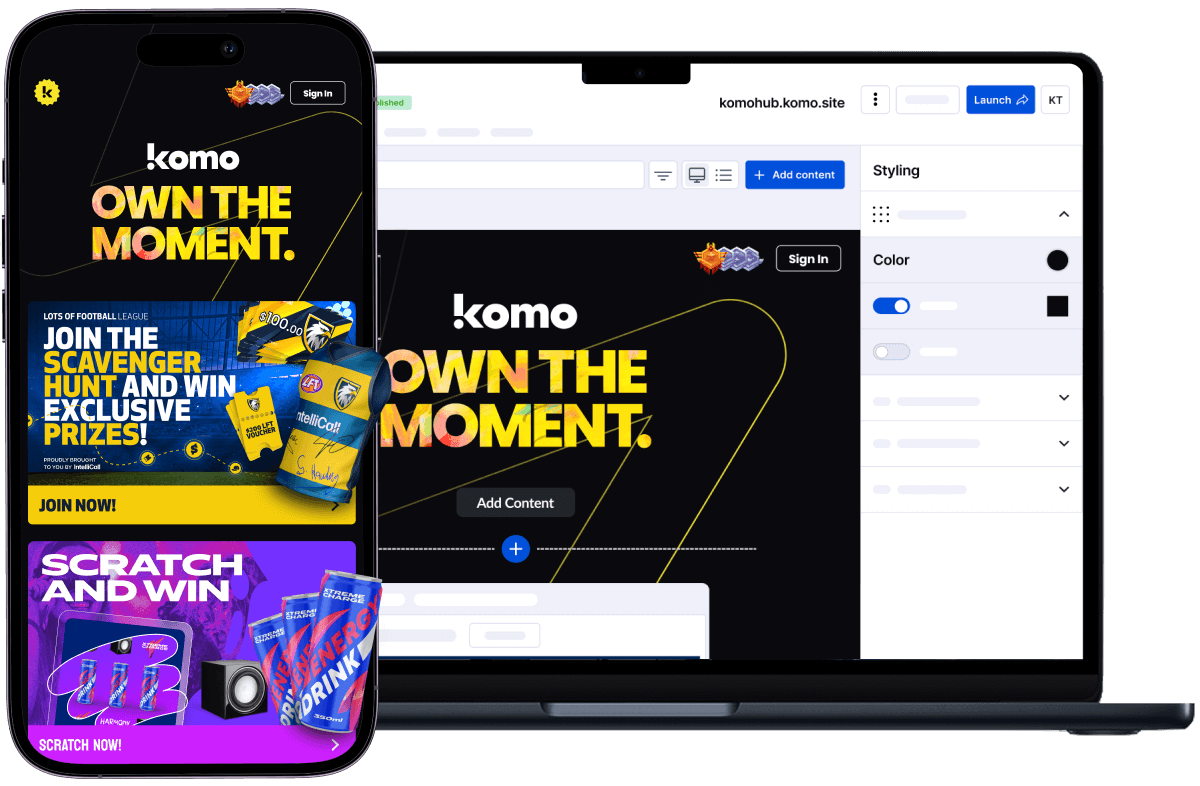
The Engagement Engine brought everything into one place: campaigns, loyalty, surveys, data capture, automation, and rewards. Not because consolidation is trendy, but because the old way—stitching together five tools that don't talk to each other—was killing teams. They were drowning in execution and starving for insight.
We introduced Kai, our AI co-pilot, in August. The goal wasn't to add AI for the sake of it. We'd seen too many platforms slap "AI-powered" on a feature and call it innovation. Kai was built for one thing: making creation fast enough that teams could actually experiment. Ideas could go live the same day. Marketers could test, learn, and iterate weekly instead of monthly.
Early adopters started creating up to four campaigns in a single day. Completion rates hit 95%. That's not a product stat—that's teams finally having the speed to match their ambition.
We rebuilt Komo Loyalty from the ground up. Traditional points programs create deferred liabilities and train customers to wait for discounts. We wanted something different—loyalty that rewards real behaviors, ongoing participation, and genuine connection. No complex point mechanics. No balance sheet headaches. Just flexible programs that brands of any size could launch in minutes.
And we reimagined how surveys work. Most survey tools interrupt the experience. Ours became part of it—embedded in games, content, and loyalty flows. Response rates jumped because we stopped treating data capture as a separate step and started treating it as a natural part of engagement.
We also introduced the Engagement Maturity Model. A lot of teams told us they weren't sure where they stood. Were they ahead? Behind? Stuck? The model gave them a clear benchmark and a practical path forward. It became one of the most-used tools in customer conversations—not because it sold product, but because it helped people see their situation clearly.
What customers made real
But here's the thing: none of that matters if customers don't do something with it.
They did.
At the Shopping Centre Council of Australia Marketing Awards in October, six Komo-powered campaigns were finalists. Five took home awards—winners and runners-up across categories spanning brand partnerships, community engagement, innovation, and retailer marketing.
QIC's "We Build Champions" campaign engaged over 27,000 kids through sport-themed experiences. Charter Hall's "Drawing Us Together" collected 282,000 votes on student artwork celebrating First Nations voices. Their "Shop. Earn. Claim" loyalty pilot delivered results strong enough to greenlight expansion across more centres. Elara Village turned Harmony Day into an interactive celebration. QIC brought movie magic to retail with a Valentine's campaign tied to Bridget Jones.
Different brands. Different objectives. Same pattern: interactive experiences that captured real data, drove genuine participation, and created measurable outcomes. You can read the full story of these campaigns here.
When we launched Kai in August, the response caught us off guard. Sports Business Journal ran a deep dive on platform consolidation for sports. Event Industry News, Mumbrella, B&T, BizBash, Mi3, Yahoo Finance—they all covered it. Not because AI is new, but because the application was different. This wasn't AI for AI's sake. It was AI that actually shipped outcomes.
Kristina Rogers, VP of ReedPop's Global Comics Portfolio, put it simply: "Komo has supercharged the way our event connects with our over 250,000 attendees. The power and flexibility of the Engagement Engine have made bringing our team and sponsors' ideas to life easy and fast, meaning we can do much more with much less."
You can see how ReedPop built their engagement system here.
That last line—"much more with much less"—might be the most important phrase of the year. Every team we talked to was under pressure to deliver more impact without adding headcount. The ones who succeeded weren't working harder. They were working differently.
Recognition that matters
G2 badges aren't something we chase. But when the people using the platform every day rate it, that matters more than any feature list.
Across Spring, Summer, and Fall 2025—and into Winter 2026—Komo earned consistent recognition in the Digital Experience Platforms category: Leader, Best Support, Easiest to Do Business With, Fastest Implementation, Best Estimated ROI, and High Performer.
The "Fastest Implementation" badge might be my favorite. Speed to impact has always been core to what we believe. If a platform takes months to deploy, it's already failed. Teams need to move now, not next quarter.
Showing up for the industry
We didn't just build this year. We showed up.
Event Tech Live London became a real partnership—we joined as technology partner, speaker, and sponsor. We powered the event's engagement experiences and earned finalist recognition in the Event Tech Awards for Best Use of Technology for Engagement & Interaction and Best Use of Technology at a Sporting Event. We didn't take home trophies, but we learned a lot standing alongside the companies pushing this industry forward.
We hosted webinars that turned into ongoing resources. With Event Industry News, we explored how to create always-on engagement that outlasts the event. With Shopping Centre News, we dug into winning the modern shopper. Both sessions are available on-demand for teams planning their 2026 strategies.
We joined conversations at RainFocus INSIGHT and FestForums. We listened more than we talked. And honestly? Those conversations shaped a lot of what we're building next.
What comes next
2025 set a foundation.
Engagement became more connected. More automated. More intelligent. The brands that embraced this shift aren't going back to running isolated campaigns and hoping for the best. They've seen what compounds.
We're already deep into what's next. The roadmap for 2026 is informed by every conversation we had this year—with customers, with partners, with the teams building the future of events, retail, hospitality, and entertainment.
If you're shaping your 2026 engagement strategy, we'd love to be part of that conversation.
And to everyone who built with us this year—the customers who pushed the platform further than we imagined, the partners who trusted us with their biggest moments, the team that shipped relentlessly—thank you.
This was a good year. Let's make the next one better.
If you're shaping your 2026 engagement strategy and want to see how teams are building systems instead of running campaigns, we'd love to show you. Book a demo today.
.png)